Traditional chatbots are limited by questions and answers entered in advance
Traditional chatbots work from predefined questions and answers that people have thought up and entered by hand. This means the chatbot can only respond to questions that are explicitly included in its system.
When a user asks a question that falls outside this preset database, the chatbot gets stuck or gives a generic, unsatisfying answer. That often frustrates the user and makes for a negative experience. The limited scope of traditional chatbots makes them less effective, especially in environments where complexity or a wide range of questions is the norm. You have probably been stuck in a chatbot loop yourself. So the idea of deploying a chatbot for your organisation is unlikely to appeal to you straight away. After all, you don’t want to give a (potential) customer a bad experience. With the AI Assistant you don’t need to worry about that. It is smart, flexible, data-driven and based on your own data sources.
The AI Assistant is smart, flexible, data-driven and based on your own sources
Artific’s AI Assistant takes customer service, support departments, knowledge bases and internal processes to a higher level. Instead of relying on a limited database of preset questions and answers, this assistant uses internal and external data sources that the organisation has defined and validated itself to answer questions.
How does the AI Assistant work?
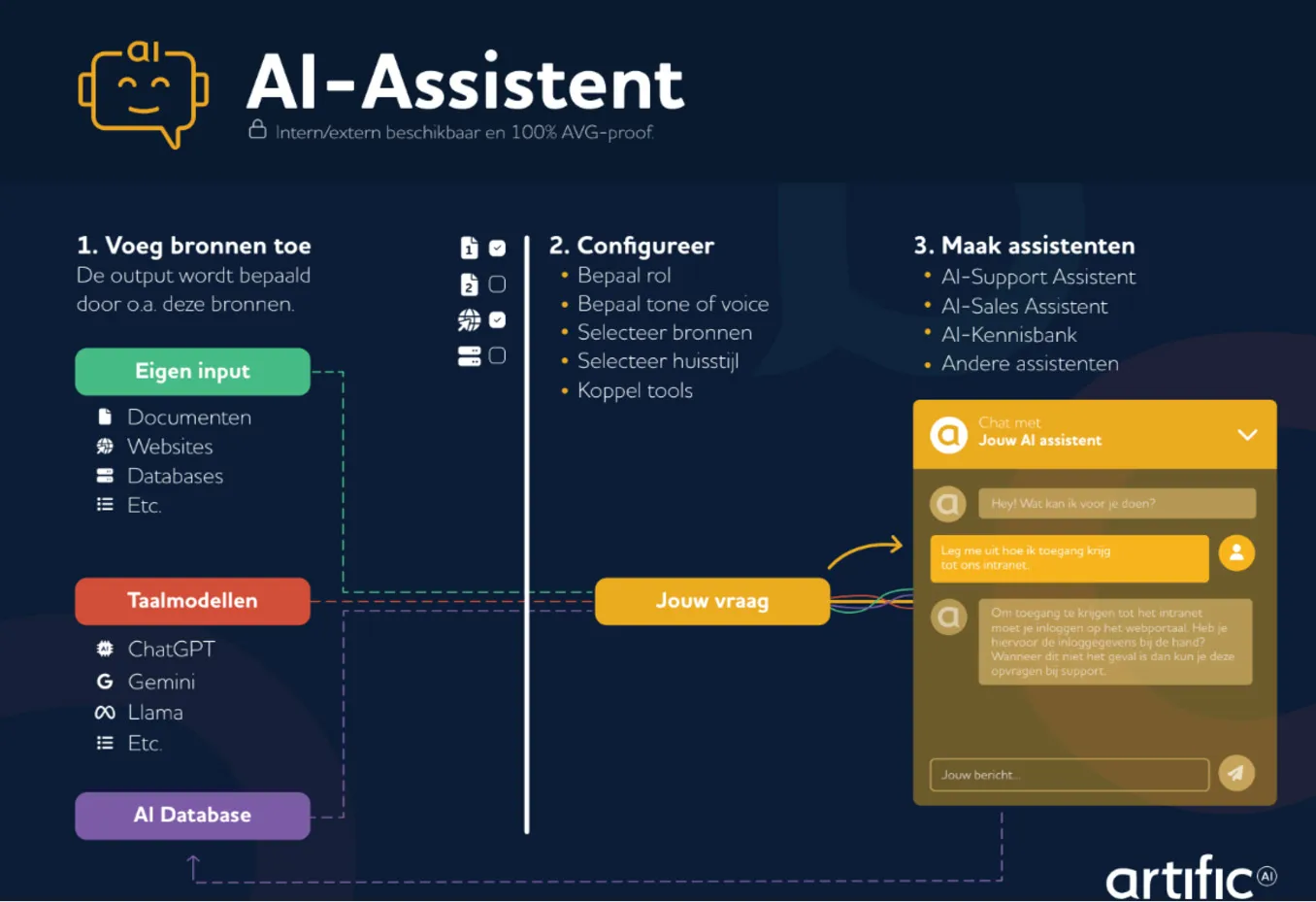
The AI Assistant uses data sources you specify yourself. Depending on the process that needs improving, and on where the answers to the questions can be found, it draws on internal and external data sources. These data sources are then queried using AI technology, after which the answer is generated. As an organisation you can also define the role yourself: how you want the AI Assistant to handle the data and which tone of voice it uses to answer the questions. Depending on what the customer wants, there are several communication channels for asking and answering questions. This can be directly through the chat, by email or by voice. The AI Assistant can also answer questions in 30 languages, whatever the language of the source.
- Internal data sources: the AI Assistant can draw on information available within the organisation, such as CRM or ERP systems, manuals, knowledge bases, internal reports and other relevant documents or websites.
- External data sources: when needed, the AI Assistant can fetch additional information from external sources, such as supplier databases, public databases, scientific articles or reliable online information.
- AI technology: to answer questions well, it uses AI technology such as Large Language Models (LLMs). The system is completely independent of any one language model and uses the power of several language models.
- GDPR-proof, with data stored within the Netherlands or on your own servers: the AI Assistant fully meets the requirements of the General Data Protection Regulation (GDPR). Data is stored and processed only within the Netherlands or on the customer’s own servers, which guarantees optimal data security and compliance.
- Communication channels: the AI Assistant can receive and answer questions through chat, email, WhatsApp and voice. Which options a user is offered is agreed with the customer in advance.
- Multilingual assistant: thanks to AI technology, it can answer questions in more than 30 languages.
This unique combination of data access and AI technology enables the AI Assistant to answer almost any question accurately and quickly. The result is not only satisfied users, but also a huge gain in efficiency for the companies and non-profit organisations that use the AI Assistant.
More efficiency and higher customer satisfaction
The difference in performance is clear:
- With a traditional chatbot, a large share of the questions goes unanswered, which often leads to dissatisfaction and lost time.
- Artific’s AI Assistant answers almost every question correctly and appropriately. That speeds up the workflow and gives users a positive experience.
What is more, the AI Assistant can keep learning and improving as you add new data sources and it recognises patterns in the questions. The role is always easy to refine as well, so you can shape the AI Assistant entirely to your needs and it does exactly what you expect of it. That makes the system not only future-proof, but smarter the longer it is used.

Conclusion
The difference between Artific’s AI Assistant and a traditional chatbot is like night and day. Where traditional chatbots are limited by the knowledge entered into them in advance, the AI Assistant offers a dynamic and comprehensive solution that draws on internal and external sources, backed by the latest AI technology to interpret and answer questions. The result is better answers, more efficient processes and higher customer satisfaction.
The ROI of an AI Assistant is so easy to achieve in every case that it is almost surprising you haven’t used one before. Improving processes, speeding them up, making them more efficient, taking away tedious or redundant work: with the right use of AI in your organisation, all of this is possible.
Curious how Artific’s AI Assistant can support your organisation? If you would like to know more about our platform, get in touch with us. We are happy to help.